


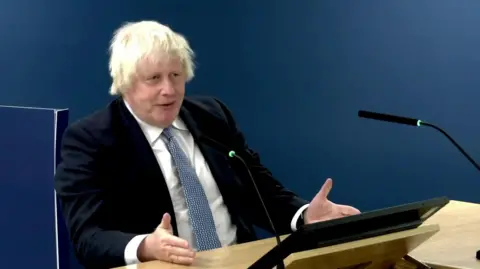
 Official Investigation Session
Students paid a "massive cost" to safeguard the public during the Covid crisis, the former prime minister has told the inquiry examining the effect on youth.
The former leader echoed an expression of remorse delivered earlier for matters the authorities mishandled, but stated he was satisfied of what educators and educational institutions achieved to deal with the "unbelievably challenging" situation.
He responded on earlier assertions that there had been insufficient strategy in place for closing down learning institutions in the initial outbreak phase, saying he had presumed a "considerable amount of deliberation and planning" was already applied to those judgments.
But he said he had also wished learning facilities could stay open, calling it a "terrible concept" and "individual dread" to shut them.
Previous Testimony
The inquiry was told a approach was merely made on the 17th of March 2020 - the date before an statement that schools were closing down.
The former leader told the investigation on the hearing day that he acknowledged the criticism concerning the lack of strategy, but noted that implementing modifications to learning environments would have demanded a "significantly increased state of understanding about the pandemic and what was expected to happen".
"The rapid pace at which the illness was progressing" complicated matters to prepare regarding, he continued, explaining the primary emphasis was on striving to avoid an "devastating medical emergency".
Disagreements and Exam Grades Disaster
The investigation has additionally learned before about numerous disagreements between government officials, including over the judgment to close educational facilities once more in 2021.
On that day, Johnson stated to the investigation he had hoped to see "mass testing" in schools as a method of maintaining them operational.
But that was "unlikely to become a runner" because of the new coronavirus variant which emerged at the concurrent moment and increased the spread of the illness, he said.
Included in the most significant challenges of the crisis for both authorities occurred in the assessment scores fiasco of August 2020.
The learning department had been forced to go back on its application of an formula to assign outcomes, which was created to avoid elevated marks but which rather saw 40% of expected grades downgraded.
The general outcry led to a reversal which signified students were finally given the grades they had been predicted by their educators, after national assessments were abolished previously in the period.
Considerations and Future Pandemic Preparation
Citing the tests crisis, investigation counsel proposed to Johnson that "the entire situation was a disaster".
"Assuming you are asking the pandemic a disaster? Yes. Was the absence of schooling a tragedy? Yes. Was the absence of assessments a catastrophe? Absolutely. Was the letdown, resentment, frustration of a significant portion of young people - the additional disappointment - a disaster? Absolutely," Johnson remarked.
"However it should be viewed in the perspective of us trying to manage with a far larger catastrophe," he continued, mentioning the loss of education and exams.
"Overall", he commented the schools authorities had done a pretty "heroic job" of striving to deal with the crisis.
Later in the day's testimony, Johnson said the confinement and social distancing regulations "likely did go overboard", and that young people could have been spared from them.
While "with luck such an event not occurs once more", he said in any potential subsequent pandemic the closure of schools "truly must be a measure of last resort".
The current session of the coronavirus inquiry, looking at the consequences of the pandemic on children and adolescents, is due to end soon.
